Why a Basketball Screen Creates a Split-Second Choice
A basketball screen changes the defender’s route and forces a quick choice. Learn how the ball-handler and screener can read the space it creates.
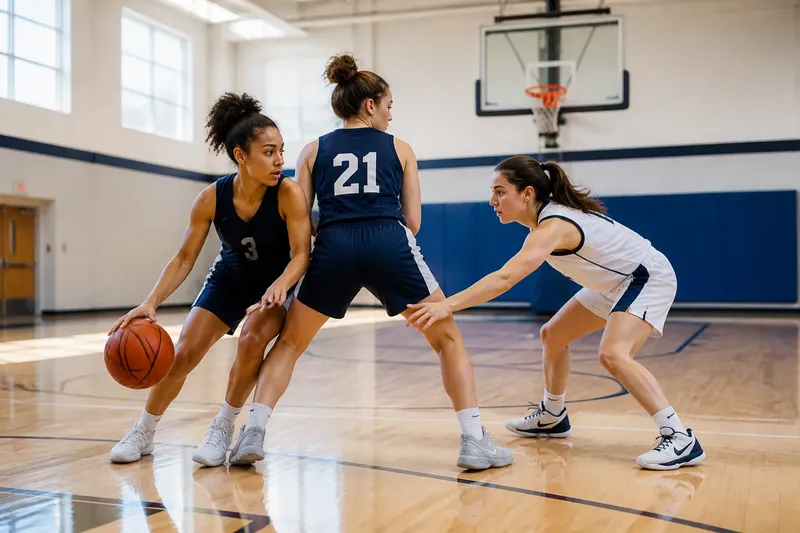
In a quiet gym, a guard dribbles towards the top of the key while a teammate waits nearby, feet set and shoulders square. The defender follows close behind. When the teammate steps into the defender’s path, the guard’s basketball screen creates a split-second choice: follow around, go over, or switch to the other attacker. The screen matters because it changes the defender’s route—and gives both offensive players a new decision.
The invented possession
Say a hypothetical school team has the ball late in a practice possession. Maya, the guard, dribbles with her right hand above the three-point arc. Her defender is close enough to contest a shot. Leon, her teammate, moves from the wing and plants near the defender’s path, leaving space for Maya to turn towards the middle.
Leon is not simply blocking a route like a gate. He must arrive under control, hold a legal position and give the defender room to avoid contact. Maya, meanwhile, has to time her movement so the screen is useful: turning too early lets her defender stay attached, while waiting too long gives the defence time to prepare.
As Leon sets the screen, the defender must choose a route. Going over it may keep the defender close to Maya, but the extra distance can create a brief gap. Going under may shorten the route, but it can leave Maya room to shoot. Switching means the defender takes Leon while another defender picks up Maya. Each response changes what the attackers can do next.
Read the defender’s route
Maya should look at the defender’s hips and shoulders as she approaches the screen. If the defender follows tightly over Leon’s outside shoulder, Maya can turn towards the gap the defender has left. If the defender slips underneath, Maya can slow down and assess the open space in front of her rather than driving into a crowd.
That read is not a cue to force a particular move. The screen creates a moment to assess, not a promise of an open lane. Maya also needs to see the help defender: a teammate stationed nearer the basket may step across to stop her drive. If that defender commits, a pass to Leon may become available.
Leon has a decision too. After the screen, he can roll towards the basket, move into open space for a pass, or hold his position long enough to make the defender’s route awkward without leaning into contact. His choice should respond to what Maya’s defender and the help defender do, rather than follow a fixed script.
Choose among three responses
Imagine the defender goes over Leon’s screen and remains close to Maya’s shoulder. Maya turns towards the middle, keeping her body between the defender and the ball. The help defender steps out from the lane to contain her. Leon now sees that the space near the basket has opened, so he rolls into it. Maya can pass if the route is clear; if another defender covers Leon, she can keep the ball and look for a shot or a pass elsewhere.
Now imagine the defender goes underneath instead. Maya does not charge into the lane. She pauses beyond the screen and checks whether the defender has recovered to contest. If there is room and she is in a position she can shoot from, the screen has helped create a shot opportunity. If the defender closes quickly, Maya can attack the space before the defence resets or pass to a teammate.
In a third version, the defenders switch assignments. Maya’s original defender takes Leon, while Leon’s defender steps out to Maya. The new defender may be larger or slower, but Maya should not assume that means an automatic advantage. Leon can move towards the basket while Maya decides whether to attack, pass to him, or pull the defence towards her and find another teammate.
Keep the screen legal
A screen is a positioning action, not permission to shove or impede a defender who cannot see the screener. Leon needs to establish a stationary position and allow the defender a chance to avoid contact. If he moves into the defender’s path at the last moment, leans, or extends an arm to make contact, an official may call an illegal screen. Exact interpretations depend on the competition’s rules, so players should follow their league’s guidance.
For Maya, the practical lesson is to use the space without crashing into Leon. She should approach close enough that her defender cannot simply slip between them, then turn with control. If the screen is poorly placed, she can reject it—move away from Leon instead of using it—and make the defence react to that route.
What should you watch?
Why does the ball-handler change direction?
The turn makes the defender negotiate the screen, which can separate the defender from the ball-handler or alter the angle of pursuit. The ball-handler can also reject the screen if the defence overcommits to protecting against it.
What does the screener do after contact?
The screener reads the defenders and moves into useful space, often towards the basket or into an open passing lane. A roll is only useful if the ball-handler can see and reach that route safely.
When should the ball-handler pass?
A pass becomes an option when a defender leaves a teammate to stop the ball-handler, or when a direct lane opens. The player should check for defenders between passer and receiver instead of forcing a pass because the screen has been used.
Can a screen work without a shot?
Yes: it can change defensive assignments, draw help, or give a teammate room to move. The resulting advantage may be a pass or a better position rather than a shot by the player using the screen.
Carry the read forward
In the invented possession, suppose Maya sees the help defender leave Leon’s path and makes a controlled pass as he rolls. Leon catches it near the basket, but a second defender arrives, so he passes out to an open teammate rather than forcing a finish. The sequence began with one screen, yet its value came from recognising how the defence adjusted at each moment.
When watching basketball, follow the defender who has to work around the screen, then notice who moves to cover the ball-handler. That brief exchange reveals the choice the screen created. For players, the same habit is useful in practice: make the screen, look up, and let the defenders’ response guide the next action.