Offside Is Not the Same as Standing Beyond the Defence
Offside position is not automatically an offence: learn when a player beyond defenders becomes involved and how to read the assistant referee’s decision.
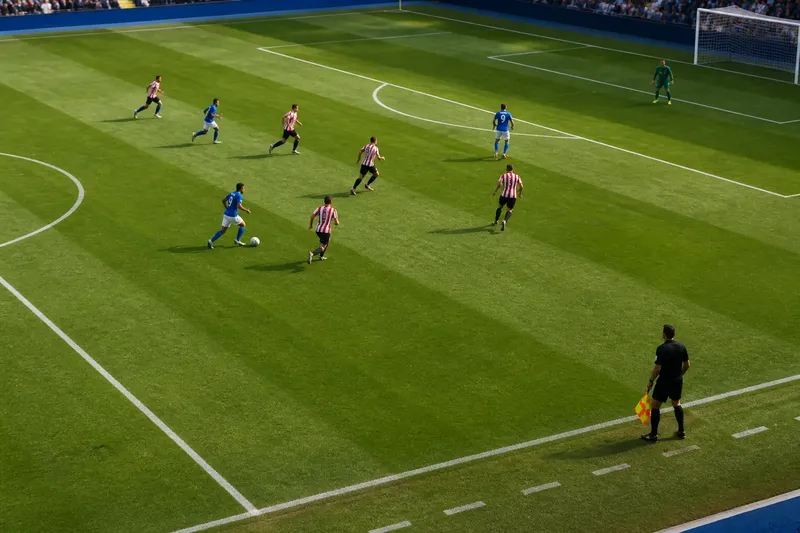
A forward waits near the halfway line while a teammate carries the ball towards the penalty area. The forward is clearly beyond the last defenders, but the assistant referee’s flag stays down. That is not a missed call: offside position alone is not an offence. In football, offside depends on where a player is when a teammate plays the ball and what the player does next.
What is offside position?
A player is in an offside position if, at the moment a teammate plays or touches the ball, the player is in the opponents’ half and nearer to the opponents’ goal line than both the ball and the second-last opponent. Being level with the second-last opponent, level with the ball, or in the player’s own half means they are not in an offside position.
The goalkeeper is often the last opponent, but the rule counts opponents, not roles. If the goalkeeper has advanced, an outfield defender may be the last opponent; the second-last opponent is then whoever is next nearest the goal line. The ball also matters: a player can be ahead of the defenders but level with or behind the ball and therefore not offside.
Position is judged at the instant the teammate plays or touches the ball, not when the receiver collects it. A forward can run back onside before the pass, or begin onside and run beyond the defence after the pass, without being caught in an offside position for that play.
Is standing beyond defenders an offence?
No. A player may stand in an offside position without committing an offence. The referee penalises the player only if, when a teammate plays the ball, they are in that position and then become involved in active play in one of the ways defined by the rule.
This distinction lets attacking players hold a high position without automatically stopping the game. The practical question is not simply, “Was the attacker past the defenders?” It is, “Were they in an offside position when the ball was played, and did they then affect the play?”
What counts as involvement?
A player in an offside position commits an offence by interfering with play, interfering with an opponent, or gaining an advantage from that position. These are separate routes to an offence, but each requires more than simply being present beyond the defence.
- Interfering with play: playing or touching the ball passed or touched by a teammate.
- Interfering with an opponent: obstructing an opponent’s line of vision, challenging them for the ball, clearly attempting to play a nearby ball in a way that affects them, or making an obvious action that affects their ability to play it.
- Gaining an advantage: playing the ball or interfering with an opponent after the ball rebounds or is deflected to them from an opponent, or comes to them after a deliberate save.
For example, say a teammate sends a low cross towards the goal and an attacker, already in an offside position, touches it into the net. The attacker has interfered with play, so the assistant referee should flag. If that attacker leaves the ball alone and does not affect an opponent, their position by itself does not make the play offside.
Can an offside player affect a defender?
Yes, even without touching the ball. An attacker can be penalised for interfering with an opponent if their movement or position blocks a defender’s view of the ball, challenges the defender, or otherwise clearly affects the defender’s ability to play it.
By contrast, merely being near a defender or making a run towards the ball is not automatically an offence. The referee judges whether the player’s action actually meets the rule’s threshold for affecting an opponent. A player who is in an offside position but neither touches the ball nor affects an opponent may remain unpenalised.
When does a deflection matter?
A ball that rebounds from an opponent or is deflected by one does not normally reset the offside assessment. If a player was in an offside position when their teammate played the ball and then plays that rebound, they may be gaining an advantage and can be penalised.
A deliberate play by an opponent is different. If an opponent deliberately plays the ball, that action can reset the offside phase, even if the play is poor, provided it was not a deliberate save. The decision depends on whether the opponent had control and the opportunity to pass, gain possession or clear the ball; an accidental deflection is not the same as a deliberate play.
Do all restarts allow offside?
No. A player cannot be penalised for an offside offence directly from receiving the ball from a goal kick, throw-in or corner kick. Once a teammate subsequently plays the ball, the usual offside assessment applies again.
These exceptions are useful when reading a quick attacking restart. Do not assume a forward is offside just because they are beyond the defenders when the ball comes from one of these restarts; identify who last played it and whether an exception applies.
What do viewers often ask?
Can a player be offside in their own half?
No. A player must be in the opponents’ half, excluding the halfway line itself, to be in an offside position. A player in their own half may receive a forward pass without being offside.
Is the arm counted when judging position?
No. The arms and hands of all players, including goalkeepers, are not considered when deciding whether someone is nearer the goal line than the ball and second-last opponent. The relevant playable body parts are used for the comparison.
Can a player run back to avoid offside?
Yes, if they are onside when a teammate plays the ball. A player who was in an offside position at that moment cannot avoid an offence merely by running back before touching the ball if they then become involved in play.
Why does the assistant referee wait to raise the flag?
The assistant referee may delay the signal when an attack is still developing, so the referee can see whether the player in an offside position becomes involved. The flag indicates an offence only once the relevant involvement has occurred.
How should you read the call?
When an attacker is beyond the defence, track three moments: the instant the teammate plays the ball, the attacker’s position at that instant, and what the attacker does afterwards. Check the ball’s location as well as the second-last opponent, then look for a touch, an effect on an opponent, or an advantage gained from a rebound or save.
That sequence makes offside position easier to separate from an offside offence. In short, an attacker can stand beyond defenders without being penalised; the call turns on their position at the pass and their involvement in the resulting play.