At a Volleyball Match, Follow the Three Contacts
Follow the three contacts at a volleyball match to see how a team turns a difficult reception into a deliberate attack, even from the stands.
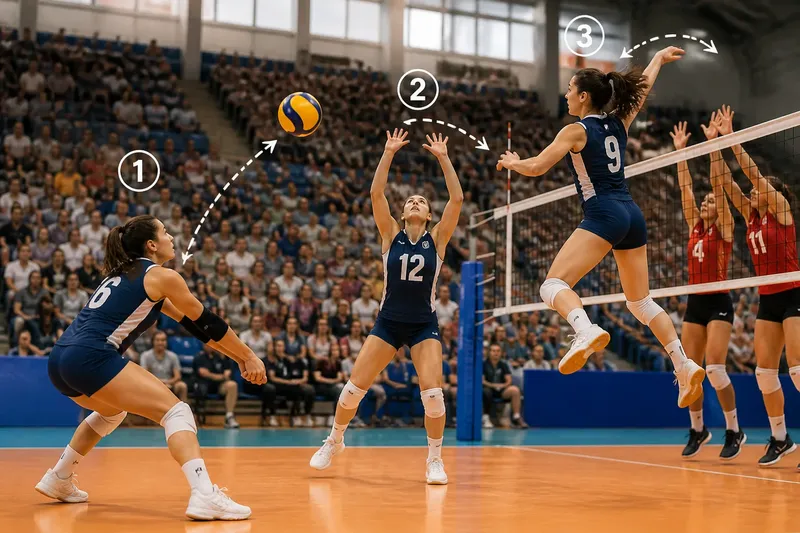
The serve clears the net, drops towards a player’s forearms and is sent high towards the front of the court. Before the ball reaches the floor, a teammate moves beneath it and sets it towards the net; another player jumps and drives it across. At a volleyball match, follow the three contacts and those quick movements become a readable sequence rather than a blur.
Use each rally as a small story: reception, preparation, and return. You do not need to identify every formation or know the players’ positions to begin. Watch who handles the ball, where the next contact happens, and what the final player is trying to make the opposing team do.
Start with the serve
Choose one side of the court to follow. When the other team serves, watch the ball’s path and the first player who touches it. That first touch is usually called the reception or pass. Its immediate job is to keep the ball in play and direct it towards a teammate who can make the next contact.
Look at the passer’s position before the ball arrives. A serve may drop into open space, travel towards a boundary, or force a player to move quickly. The passer may use a forearm platform, or another legal contact suited to the ball’s path. For your first watch, the important question is not whether the technique looks textbook; it is whether the ball travels towards a teammate rather than straight back over the net or into the floor.
Do not assume every reception goes to the setter. If the pass is off target, a different player may take the second contact. That adjustment is part of the rally: the team has to organise around where the ball actually went, not where it was meant to go.
Trace the second touch
After reception, shift your attention to the player moving towards the ball for the second contact. In a familiar attacking pattern, this is the setter, who sends a high, controlled ball towards a hitter near the net. The setter’s location and hand action can make this contact easy to spot, but the ball’s destination is the clearest clue: watch where it rises and which attacker begins an approach.
The second contact is a choice, not merely a lift. The setter may send the ball to the left or right side, place it in the middle, or use a quicker, lower set. Each option changes how much time the hitter has and where the blockers must prepare. From the stands, you can observe the choice without trying to guess the team’s full playbook.
Notice whether the setter is balanced and facing the target, or reaching to keep a poor pass alive. A difficult reception can leave the second contact high and predictable. A well-directed pass can give the setter more options. These are visible consequences of the first touch, and they help explain why two rallies that both reach a hitter can look quite different.
Watch the final contact
Follow the set to the player preparing to attack. The third contact is often a spike: the hitter approaches, jumps and contacts the ball above the net. But a team is not required to hit hard. A controlled tip, a roll shot, or a safer return may be the more useful choice if the block is well placed or the set is awkward.
Watch the hitter’s shoulders and approach, then follow the ball rather than the player. Does the attack go deep towards the back court, angle towards a sideline, or fall into an open area near the net? If blockers close the route, does the hitter send the ball around or off their hands? The aim is to make the opponent’s next contact difficult, not simply to strike the ball as forcefully as possible.
A team can also use fewer than three contacts. A reception might cross the net directly, or a player may return a ball on the second touch when the opportunity arises. The three-contact pattern is a useful way to watch common attacking sequences, not a promise that every rally will use all three.
Read the rally’s shape
Once you can follow the contacts, add one observation at a time. After the reception, look at how quickly the setter gets under the ball. As the set travels, check whether the hitter has space to approach. When the attack crosses, watch how the defending team positions its players for the next touch.
This makes the rally’s cause and effect easier to see. A pass close to the net may give the setter a straightforward option but also bring the attack near the blockers. A pass that drifts away can force a high set and give the defence time to form a block. A clean set may still meet a well-positioned defender, so the final contact’s placement matters as much as its power.
Try following just one attacker for a few rallies. Notice when they begin moving, whether they approach before or after the setter releases the ball, and where they land. Then return to the ball’s path. The player’s movement offers context, but the contacts remain the thread that lets you follow the play.
Try a sample rally
Say you are watching a match from the end of the court. A serve drops towards a receiver near the back line, who passes it towards the centre. The setter moves across, sends a high ball to the left, and the left-side hitter approaches. You see the opposing blockers close together, so the hitter uses a controlled shot into the space behind them. The expected observable result is that you can identify the reception, the set’s target, and the attack’s intended gap, whether or not the shot scores.
On the next rally, compare the sequence rather than the outcome. Perhaps the pass is too far from the setter, and a teammate sends a high ball across as a recovery. The attack may be easier to defend, yet it can still keep the team in the rally. A point tells you who won; tracing the contacts tells you what each side had to respond to.
Questions from the stands?
Does every rally use three contacts?
No. A team may return the ball on its first or second contact, especially when the ball arrives awkwardly or a quick opening appears. The three-contact pattern describes a common reception-and-attack sequence, not a requirement to use every touch.
Can the same player touch the ball twice?
As a general rule, a player may not make two consecutive team contacts, though the rules provide specific exceptions, including some first-contact situations. If a close call matters, the competition’s rules and the referee’s decision take precedence.
Is the setter always the second toucher?
No. The setter often takes the second contact when the reception is usable, but another player may step in if the ball goes elsewhere. Watch where the ball is redirected and who moves to play it, rather than assuming a particular player will always set.
What counts as an attack?
An attack is an action that directs the ball towards the opponents, usually the third contact but sometimes an earlier one. It can be a hit, tip or other legal play; it does not have to be a powerful spike.
Keep one question
For each rally, ask: where did the first contact send the ball, and what did that make possible for the next player? This keeps your attention on the team’s changing choices without requiring you to track every player at once. When the ball crosses the net, switch sides and repeat.
At your next volleyball match, follow the three contacts from reception to return, then notice which contact changed the team’s options most. A sharp pass may open several attacks; a difficult one may narrow them to a safe recovery. That small distinction gives you a practical way to read the action while the rally is still unfolding.